BYOK Credential Isolation and Its Impact on Cloud Agent Billing
Direct billing controls spend only when keys and sandboxes are designed together.
BYOK credential isolation determines more than who pays for a cloud coding agent’s model calls. It determines whether a team can track who spent what, enforce organizational boundaries, and limit misuse. Direct provider billing delivers that control only when credential scope, execution isolation, and usage attribution are designed together.
Why the term "BYOK" means two different things inside a cloud agent platform
BYOK names two different controls in cloud environments. In infrastructure security, it means bringing an encryption key so that the cloud provider stores only ciphertext the customer controls. In AI tools, it means bringing an API key that authenticates requests to a model provider. The first concerns protection of stored data. The second concerns authority to use a service and the account charged for that use.
A cloud coding agent platform must handle both boundaries, but documentation about one does not establish control over the other. A team may control encryption to meet compliance rules while its model requests still use a shared platform account. Direct model billing also leaves open who controls encryption at rest. The distinction defines the rest of this article. BYOK in cloud coding agents means the team’s API key authenticates model calls and the provider bill lands in the team’s account.
How a BYOK billing split actually works in a cloud agent run
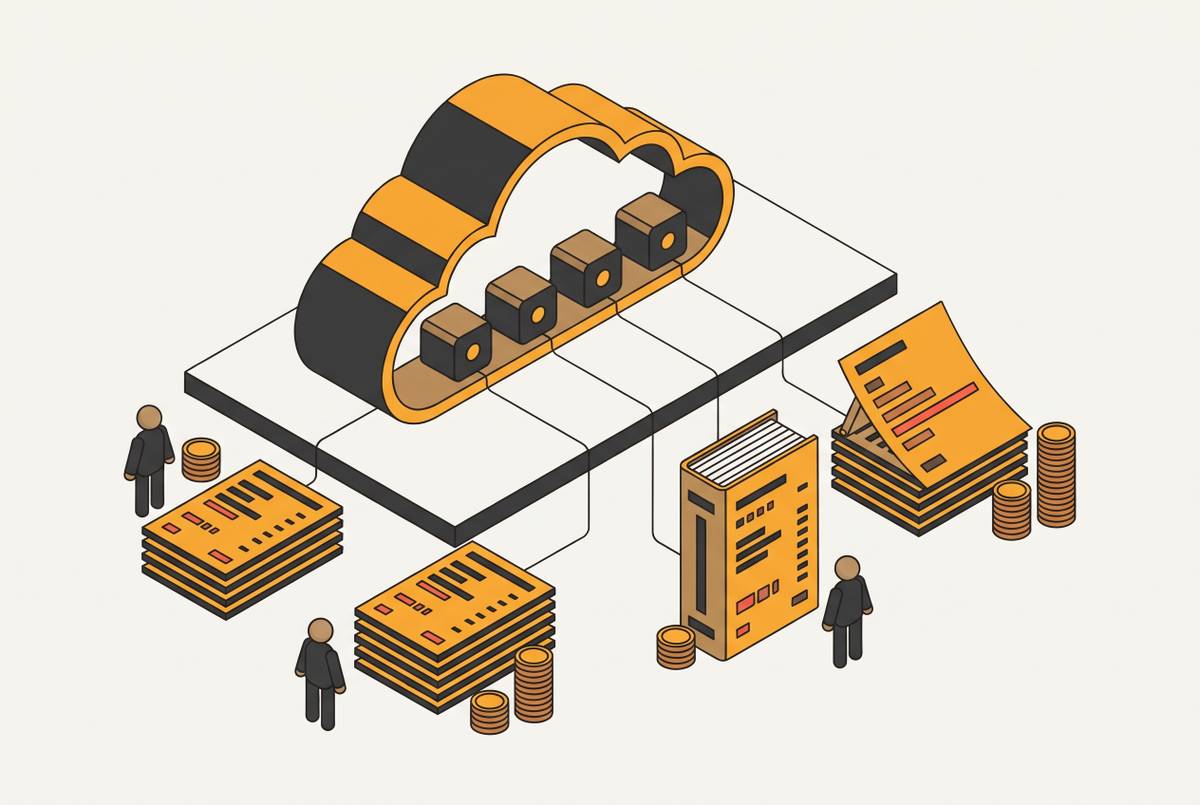
A BYOK run produces two separate billing components. The platform charges for the environment, scheduling, connectors, and orchestration, while the model provider charges for model usage without an intervening resale margin. For an illustrative run, the platform bill would contain the charge for running the agent, and the provider bill would contain its input and output token usage.
The provider charges the team’s account at the rate that applies to it, usually published list prices unless the team has negotiated rates. The account gets any prompt caching, batch pricing, and enterprise discounts it qualifies for without the platform having to do anything. The provider dashboard shows the token usage record. But linking that record to a given agent run depends on how credentials and attribution are set up, as discussed below. Switching models or providers becomes a credential change within the same platform, as on Replicas, a cloud coding-agent platform where teams run Claude Code, Codex, Cursor or OpenCode in isolated VMs on their own model accounts and get pull requests back.
With managed credits, the platform buys tokens and resells usage, often with a margin, converting the underlying consumption into platform credits. Subscription sign-in draws usage from a consumer plan such as ChatGPT Plus or Pro, within that plan’s limits and without the visibility needed for team-level attribution. Sim’s BYOK documentation makes that separation explicit by distinguishing the model usage charge that BYOK avoids from the per-run base charge that remains payable under every billing path.
Why most "BYOK" implementations are not equally real
The BYOK label does not establish who can read the credential. A client-side encryption design can encrypt the key in the browser or device before transmission, retain no key on platform servers, and use a single-use encrypted envelope for each request. TLS alone protects a different boundary. It encrypts the connection, but the key arrives at the receiving server as a readable secret. A BYOK proxy likewise places an intermediary in the request path that may hold the readable credential while handling the request.
Test whether a vendor employee with database access could read a stored API key. A genuine client-side design prevents that access through the way it is built, without having to rely on policy. That test distinguishes protection from an assurance of good behavior, although request-time handling still needs scrutiny. For agent teams, a platform-readable key extends the consequences of a platform compromise to the provider account, rate limits, and any other resources that credential authorizes.
What key-per-agent isolation actually controls beyond the credential itself
Key-per-agent isolation is a governance mechanism because it makes credential scope the boundary for attribution, access, and spending control. A distinct key per agent or workspace separates usage records that a shared key would pool. That separation gives spending an organizational owner. It also lets teams apply the relevant provider-side access tiers and limits to the agents that need them. The granularity of the key structure therefore constrains the granularity of governance.
A business unit with its own cost center needs model spending separated from the rest of the organization. A shared key instead produces a provider bill without a breakdown by agent, team, or task. A regulated subsidiary faces a related problem when it has a separate enterprise agreement with the provider. Shared credentials merge usage that the contract was intended to separate. In both cases, the billing boundary must follow the organizational boundary, rather than depend on a later attempt to divide a pooled total.
A fixed evaluation quota exposes another weakness of shared credentials. Any agent using the shared key can exhaust the quota without the key itself identifying which agent consumed it. Separate scopes make containment possible. Anthropic’s workspace model assigns keys to a workspace with alerts and a spend limit below the organization’s limit. OpenAI’s project spend limits apply to the organization or project, while non-admin project keys also allow per-endpoint restrictions.
Those controls operate at different levels and should not be conflated. A distinct key identifies an agent’s authority, but the applicable spending boundary may belong to its workspace, project, or organization. Endpoint restrictions set what the key can access. Spend limits set how much can be spent through its use. The absence of resale markup is a benefit of BYOK, but the deeper benefit comes from arranging these scopes so that account ownership, usage attribution, and organizational responsibility agree.
Why sandboxed environments and credential scoping must be designed together, not separately
Credential scope limits authority, while sandboxing limits the environment in which that authority can be exercised. Neither replaces the other’s protection against failure. A sandboxed agent with broad, standing credentials can still misuse the access it has been given. An agent with a narrow credential scope still faces risks beyond its own credential when it runs in a shared environment. The execution boundary must therefore support the account boundary before credential isolation can serve as the primary containment control.
The sandbox tier changes the strength of that boundary. A shared-kernel container offers the fastest and cheapest tier but the weakest isolation, because an escape reaches the host kernel and whatever the host can access. A user-space kernel such as gVisor intercepts and filters system calls, narrowing that attack surface without a full virtual machine. A microVM such as Firecracker gives each run a dedicated lightweight virtual machine. Of these tiers, that provides the strongest separation between an agent and neighboring execution environments.
The deployment sequence follows from those differences. Teams should set up sandboxing before they rely on scoped credentials as the main control, then replace standing credentials with scoped, short-lived tokens before they connect more tools. Otherwise, each added tool inherits the agent’s blanket authority. That sequence reduces the set of resources available when an agent misuses access. It also makes the credential boundary meaningful instead of leaving it as one narrow control inside an environment with broader paths to exposure.
How the egress-proxy model closes the gap that BYOK alone leaves open
Even a scoped credential remains exposed if the agent can read it. Standard BYOK hands the agent a credential and relies on its behavior to preserve the secret. Prompt injection challenges that assumption directly. Injected instructions can cause the agent to treat hostile directions as legitimate and potentially exfiltrate or misuse the credential it holds. A sandbox limits the execution environment, but it does not remove a readable secret from that environment.
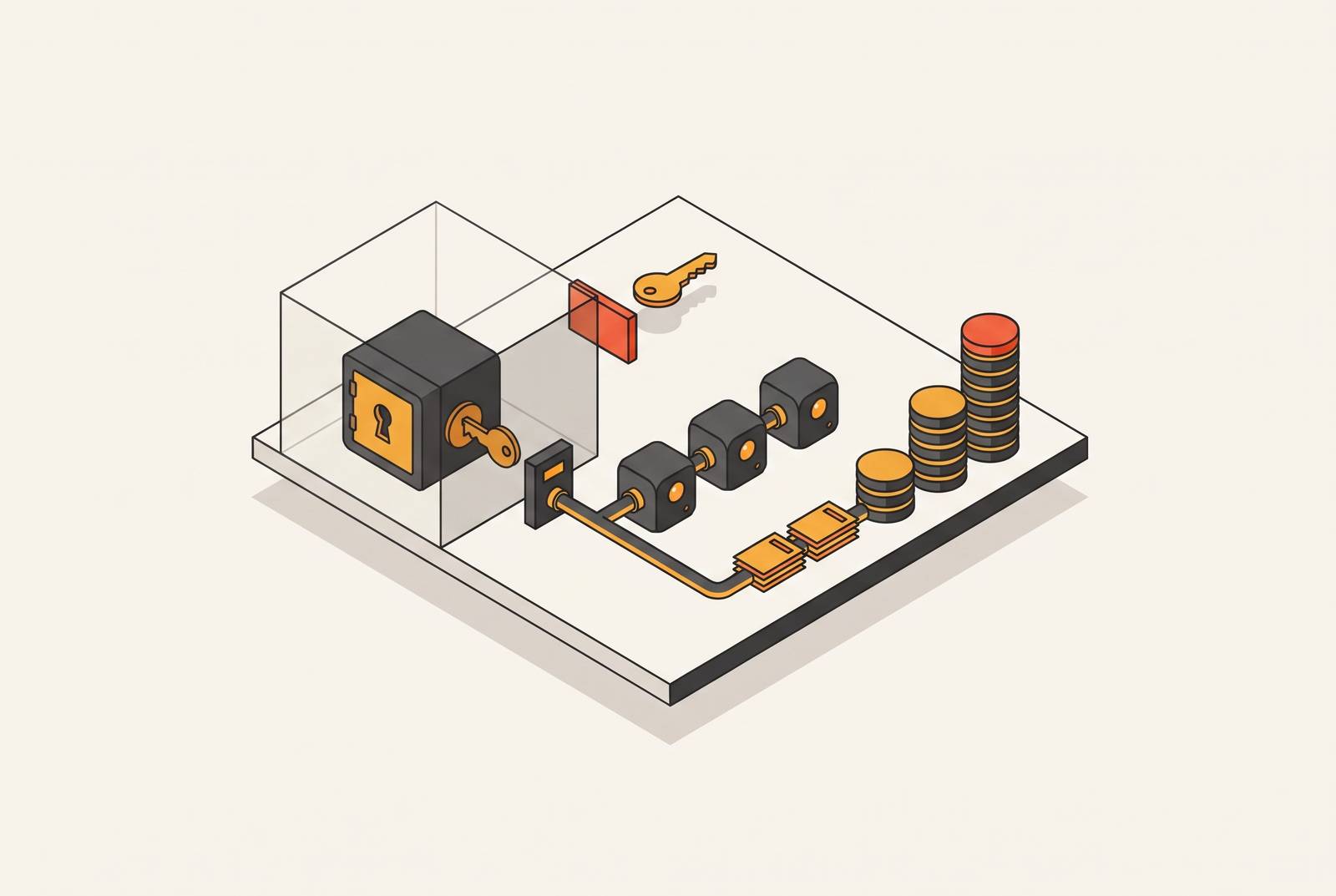
An egress proxy moves authentication out of the agent’s possession. It intercepts outbound requests and attaches the credential at the network boundary, so the agent never holds the readable key. There is no credential artifact for injected instructions to extract from the agent. This changes the protection from a behavioral expectation into a network-layer boundary.
This model addresses a different exposure from client-side encryption. Client-side protection concerns whether the platform can recover a stored secret, whereas egress injection concerns whether the agent receives a readable secret during execution. Both questions remain relevant to evaluation. A proxy that keeps credentials outside the agent does not, by that fact alone, establish that the intermediary cannot read them. The important distinction is between protecting the credential from the platform’s storage and protecting it from the agent’s runtime.
That distinction is consequential because these credentials authorize more than an isolated interaction. A provider key may charge spending to an enterprise account, while other agent credentials may give access to a GitHub organization or a cloud deployment target. Keeping readable credentials outside the agent is the natural extension of scoping its authority and isolating its environment. The network boundary enforces a control that the agent cannot be expected to police itself.
The corresponding cloud agent architecture associates each VM-isolated run with its credential scope and exposes analytics for the source, harness, model, and credential for every minute of execution. Engineers can trigger agents from Slack, Linear, GitHub, or GitLab and receive a pull request, recording, or reply without changing their workflow to obtain visibility. The billing structure operates beneath those interactions. Attribution is then part of the infrastructure design, rather than an attempt to reconstruct ownership from logs after the work has finished.
What engineering teams should verify before treating a platform's BYOK badge as a governance control
Teams evaluating a platform should begin with credential readability and scope. The storage test is whether a vendor employee with database access can read a stored API key. An architectural prohibition differs from a promise not to do so. The next test is whether the platform supports distinct keys per agent, workspace, and team, or funnels all runs through one credential. That answer establishes whether the platform can represent the organizational boundaries the team needs.
Spend controls should then be evaluated at their actual enforcement scope. Teams should establish whether the platform exposes or recommends provider-side limits and alerts for the workspaces or projects associated with agent keys. Teams need to check access restrictions separately from spending limits. Teams should also check whether the agent runs in shared containers, a user-space kernel, or a microVM. That answer indicates how strongly the runtime separates one agent’s authority from neighboring workloads.
After-run visibility and request-time credential handling complete the evaluation. Teams should establish whether they can identify the harness, model, credential, and task behind a charge. They should also ask whether network-layer injection keeps readable credentials outside the agent. A gap that is tolerable with one or two agents becomes unmanageable at team scale when attribution and isolation were not built into the architecture from the start.