Credit-Based Pricing True Cost for Engineering Teams
Agentic workloads shatter the predictability that made AI tools easy to budget.

AI coding tools changed their billing model in 2026, and the change is structural. Flat-seat licensing gave engineering leaders a predictable per-head line item for years, but it gave way to consumption-based pricing tied to tokens and credits. Under the old arrangement, a developer using Copilot for a handful of inline completions each day paid the same monthly fee as a colleague running unattended agent sessions for hours at a stretch. Token-based pricing ended that equivalence, and with it went the predictability that made AI tooling easy to budget. What used to be a fixed cost is now a variable one, and the variance is driven by behavior that most finance teams have never had to model before: how long an agent runs, how many files it touches, and how many times it calls out to a model before it finishes a task.
How the four major billing architectures work, and why they are not comparable by sticker price
Four tools dominate the market, and each one prices its product on a genuinely different mechanism, not just a different label on the same idea. GitHub Copilot runs on a seat-plus-credits structure: a base subscription paired with a monthly allotment of AI credits that varies by tier. Free, Pro, Pro+, Max, Business, and Enterprise each carry a different credit allotment and a different per-user price, and none of those tiers can be judged against another by comparing the sticker price alone. A detail many teams miss when budgeting: Copilot Enterprise, listed at $39 per seat per month, requires GitHub Enterprise Cloud as a prerequisite, which adds another $21 per user per month, bringing the effective cost to $60 per user monthly. Cursor takes a different approach: it sells a seat with a usage allowance framed around capacity, a model built on a dollar-denominated credit balance. Its jump from a Standard tier to a Premium tier is Cursor's own acknowledgment that background and parallel agents consume far more capacity than inline suggestions do, and the company prices that distinction into a separate tier. Claude Code and Codex price on still different logics, one favoring a flat ceiling and the other favoring exact per-token metering, a distinction that matters enormously once agentic workloads enter the picture. Four vendors have built four incompatible accounting systems, and a team that lines up headline prices side by side learns almost nothing about what its actual bill will look like in a given month.
How Promotional Credits Masked the Real Baseline
Launch-era promotions in 2026 built extra credit allotments into several of these plans, so teams could not yet see what the real monthly cost would eventually be. GitHub Copilot Business and Enterprise seats carried elevated promotional credit allotments between June and August 2026. When that window closed, included organizational allowances dropped back to standard levels, and the exact same usage pattern that once fit comfortably inside the promotional allotment now began generating overage charges. The effect compounded in a particular way: as teams adopted agentic workflows during the promotional period, their usage patterns shifted upward in response to the apparent abundance of credit, so when the subsidy ended, the gap between what was included and what was actually being consumed was wider than it would have been had the team adopted agents under standard pricing from the start. If a team calibrated its sense of normal cost against a subsidized number, it was budgeting against a baseline that never reflected the platform's real price. That discovery, arriving as an invoice rather than a warning, is the moment many engineering leaders first understood how much agentic work actually costs.
What agentic workloads cost per task, and why the gap between inline and agentic spend is not linear
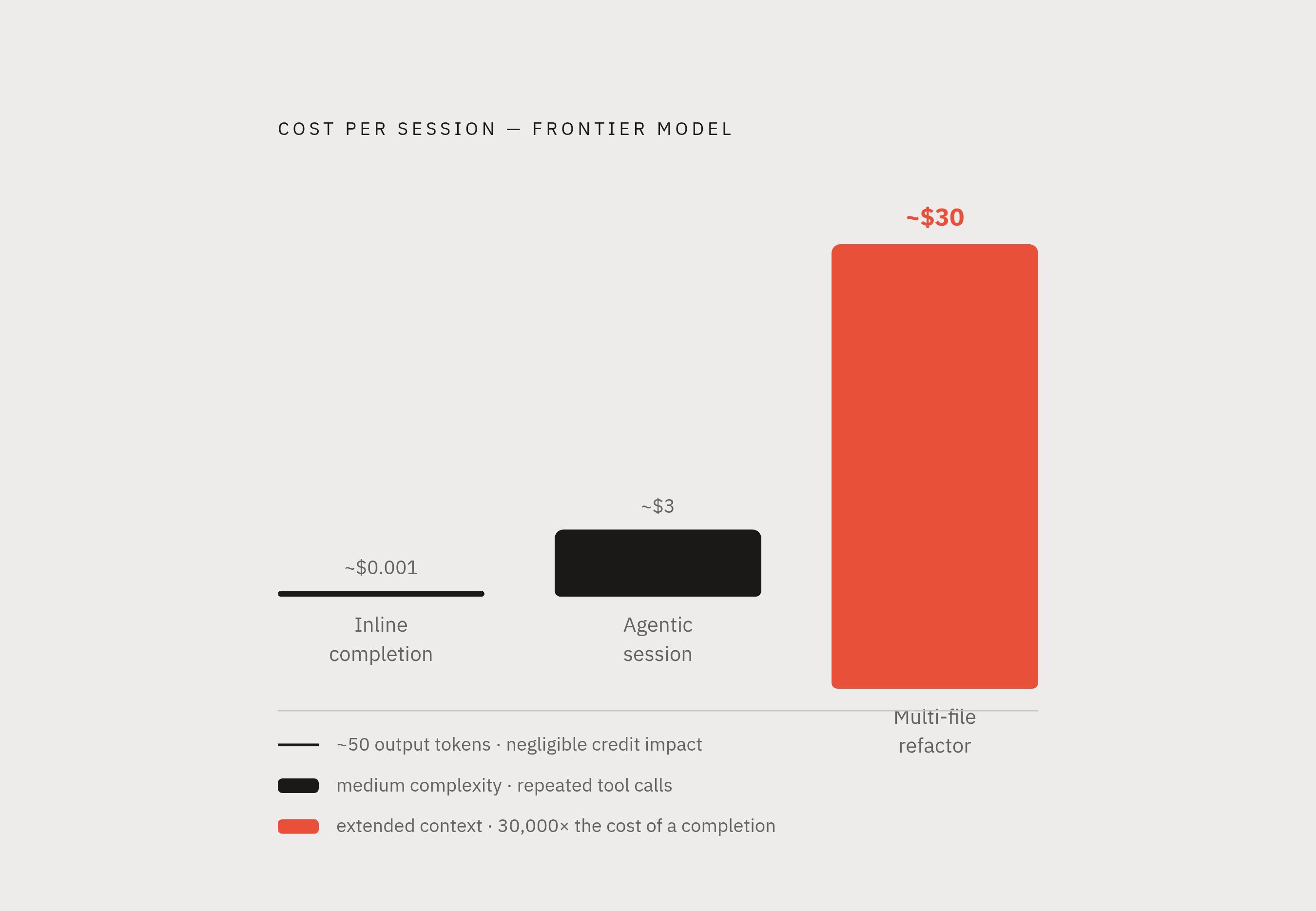
The cost difference between an inline suggestion and an autonomous agent session is a difference in kind, not degree, and the per-task numbers make that plain. A short inline completion generates around 50 output tokens on a frontier model, so it costs a negligible fraction of any plan's included credit allotment and barely registers against a monthly budget. An agentic session that generates a large volume of output tokens on that same frontier model can cost several dollars out of that allotment, and a complex refactoring session spanning multiple files, extended context windows, and repeated tool calls can consume far more, easily running into tens of dollars in credits at frontier model rates. Measured per medium-complexity task, the cost ladder across tools shows real separation: GitHub Copilot is at the low end, Cursor runs somewhat higher, Claude Code Max higher still, and Devin tops the range for simple tasks and climbs further for complex ones. The real budget risk lives in the tail of that distribution, and a handful of engineers running long autonomous sessions can spend several times the team median in a single month. The common objection, that token cost is small relative to developer salaries, holds at the median but misses how the tail behaves once many agentic sessions run in parallel without spend controls in place.
How the Cost Compounds at Team Scale
Individually manageable credit costs become structurally unpredictable once a team scales them up, because agentic usage is never distributed evenly across an engineering organization. A representative 10-engineer team on Copilot Business illustrates the pattern: at moderate agentic workloads, token spend against the included credit allotment produces meaningful monthly overage, and at heavy workloads that overage can run several times the base seat cost. The seat fee functions as a floor. Daily autonomous agent work commonly lands in a wide cost range per developer per month regardless of which plan or tool a team has chosen, because at that intensity the cost is driven by compute consumption. The market has effectively settled into two bands: a low band covering completions and basic chat, and a substantially higher band covering autonomous agents running in parallel. The real budgeting question for any team is which band each developer falls into, not which vendor advertises the lower sticker price. That distribution is skewed further by seniority: senior engineers lead AI agent adoption and run heavier workloads, while junior engineers tend to use agents less intensively, so a team's aggregate cost is not a straight multiple of headcount. A governance gap compounds the problem. Teams that set spending budgets at the individual plan level rather than at the organization level lose visibility into aggregate spend before the invoice arrives. GitHub's own org-level budget controls include optional threshold alerts, but per-user budgets are always hard stops, while org-level budgets only govern metered overage after the shared credit pool is exhausted, and those alerts are off by default. A team relying on per-user caps alone will not see the aggregate number moving until it is too late to act on it.
The Pricing Model's Failure Mode Matters More Than Its Sticker Price
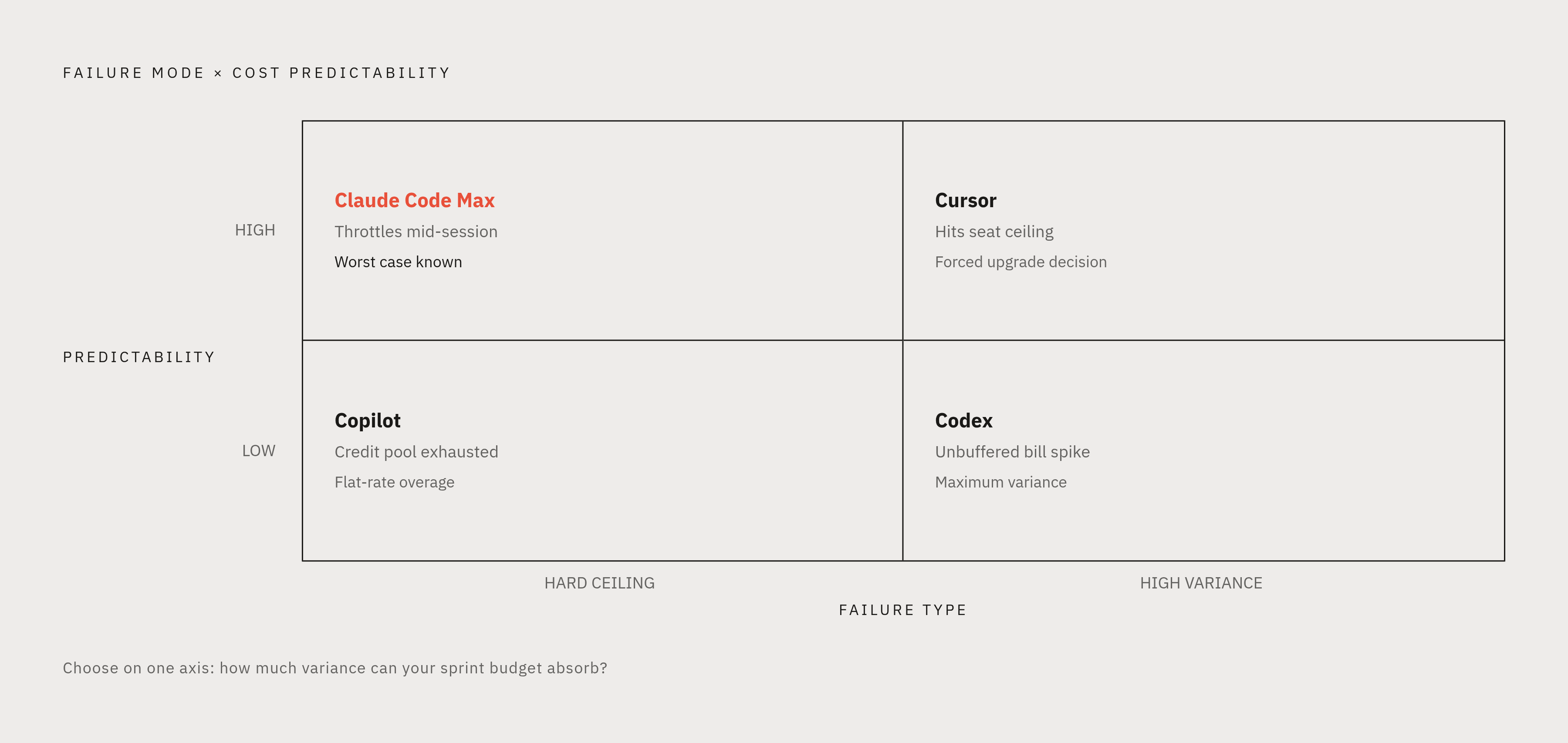
Because all four major tools converge on similar spend once agentic use gets heavy, the decision that actually matters is not which vendor is cheapest but which vendor's failure mode a team can tolerate. Claude Code's flat Max tier makes the worst case known in advance: the failure mode is throttling mid-session when rolling window limits are hit. Codex's token metering sits at the opposite end of that spectrum, tracking what gets consumed with maximum transparency, but that precision produces the highest variance of the four models, and its failure mode is a large, unbuffered bill after an unusually heavy month. Copilot's credit allowance model smooths variance up to the allotment and then bills overage at a flat rate past it, so its failure mode is exhausting the credit pool mid-sprint if agentic sessions go unmonitored. Cursor's tiered seats force a conscious decision about usage intensity the moment a team steps from Standard to Premium, and its failure mode is underprovisioning against the ceiling. The practical implication follows directly from these distinctions: a team that wants a hard ceiling should choose Claude Code's flat Max tier, a team that wants to pay exactly for what it uses and can tolerate variance should choose Codex's token metering, and a team that wants a buffer to smooth month-to-month spend should lean on Copilot or Cursor seats. Locking into a single vendor's billing model means accepting that model's failure mode indefinitely, and as frontier models continue to improve, the tool whose pricing fits a team's risk tolerance today is not guaranteed to be the tool whose capability fits its needs next year.
Managing Credit Spend Across Agents Running Autonomously at Team Scale
Managing credit spend at team scale demands operational controls that most teams simply do not have in place when they first adopt these tools, and that gap exists because the workflows that make agents valuable, autonomous, parallel, and long-running, are the same workflows that accumulate token cost fastest and with the least visibility. One dev team guide covering GitHub Copilot AI credits in 2026 recorded developers who reported bills 25 times higher than what they had paid before agentic use became routine. Closing that gap starts with classifying developers before provisioning plans: counting how many engineers run mostly inline completion and chat against how many run autonomous agents for hours at a time, since the first group fits comfortably into the low spend band on nearly any platform while the second group will cost real money regardless of which tool it uses. Benchmarking representative tasks before you deploy broadly matters just as much, because an agent that iteratively edits and re-evaluates its own output across many turns accumulates usage that is hard to predict without measurement, and running a cost benchmark against a sprint's worth of typical tasks gives a team a defensible number before it scales adoption further. Credit limit alerts configured at the organization level create visibility before an overrun occurs rather than after it appears on an invoice, and the same principle holds across every platform in this market, since team-wide spend dashboards surface the tail usage that individual plan caps miss. Autonomous agent sessions deserve particular scrutiny here, whether they run as Copilot Workspace jobs, Claude Code background runs, or Codex scheduled tasks, and their representative credit cost should be benchmarked before they are allowed to run unattended at scale. The missing layer for most teams is attribution: knowing which agent, which model, which task type, and which integration triggered a given spend is what separates engineering leaders who can distinguish signal from noise from those staring at an aggregate number with no way to explain it. Running each agent in its own isolated environment with scoped permissions and a full audit trail is not simply a security practice, it is the precondition for attribution in the first place, since shared environments make it structurally impossible to trace spend back to a specific task or integration. Replicas builds its product around exactly this operational model, running agents in isolated VMs and generating analytics down to the source, the person, the harness, the model, and the credential responsible for every minute an agent runs, across Claude Code, Codex, Cursor, or Opencode. The structural shift toward consumption pricing is especially visible for teams running agents at this kind of scale rather than relying mainly on inline suggestions: platforms that isolate each agentic task in its own environment and trigger a discrete billing event per task make the real size of that shift legible in a way that marginal increases to a seat license never did. That same isolation cuts both ways on cost. A fully configured, isolated environment lets an agent install dependencies, run extended tool calls, and repeat operations without the performance degradation that shared environments tend to produce, so agents in that setting will tend to run longer and consume more tokens than inline suggestions ever would. The tail of the cost distribution is heavier than most teams expect when they budget purely from sticker price. Predictability at this scale is ultimately an infrastructure problem as much as a pricing-model problem, and a team that solves only the latter will still find itself unable to explain its bill.
Building an Honest Per-Developer Budget Model Before Agents Run at Scale
The teams that avoid invoice shock are not the ones that picked the cheapest plan on the market. They are the ones that classified their own usage patterns, benchmarked real task costs against real workloads, and put spend controls in place before autonomous agents were running broadly across the organization. That work starts by classifying developers by usage band rather than by job title or role, separating those doing mostly completions and chat from those running autonomous agents for extended periods, and provisioning plans to match those bands rather than standardizing the entire team on a single tier. From there, a one-month cost pilot run on a bounded subset of the team gives a far more honest number than any vendor's pricing page: tracking actual token spend per developer, per task type, and per integration shows that the seat fee is only the floor, and the pilot reveals the real figure sitting above it. The budget itself should be set from the 90th-percentile user rather than from the median, because the tail of usage decides whether a quarterly budget actually holds, and the average developer's monthly spend will always understate what the team is exposed to at scale. Choosing a pricing model whose failure mode matches the team's risk tolerance follows naturally from that work: a flat ceiling like Claude Code's Max tier suits a team for which variance is the primary risk, token metering through Codex suits a team that values transparency over smoothing, and an allowance model through Copilot or Cursor suits a team that wants a buffer before overages begin to bite. Building spend attribution before scaling holds this together. A team that cannot trace credit spend back to a specific task, integration, or agent run will always be managing its budget in reaction to the last invoice rather than in anticipation of the next one, and per-run attribution is the operational primitive that turns scaling from a gamble into something a team can actually plan around.