Mapping Agent Spend to Org Chart Lines a VP of Engineering Already Recognizes
Agent costs fit tooling, infrastructure, and capacity budget lines.
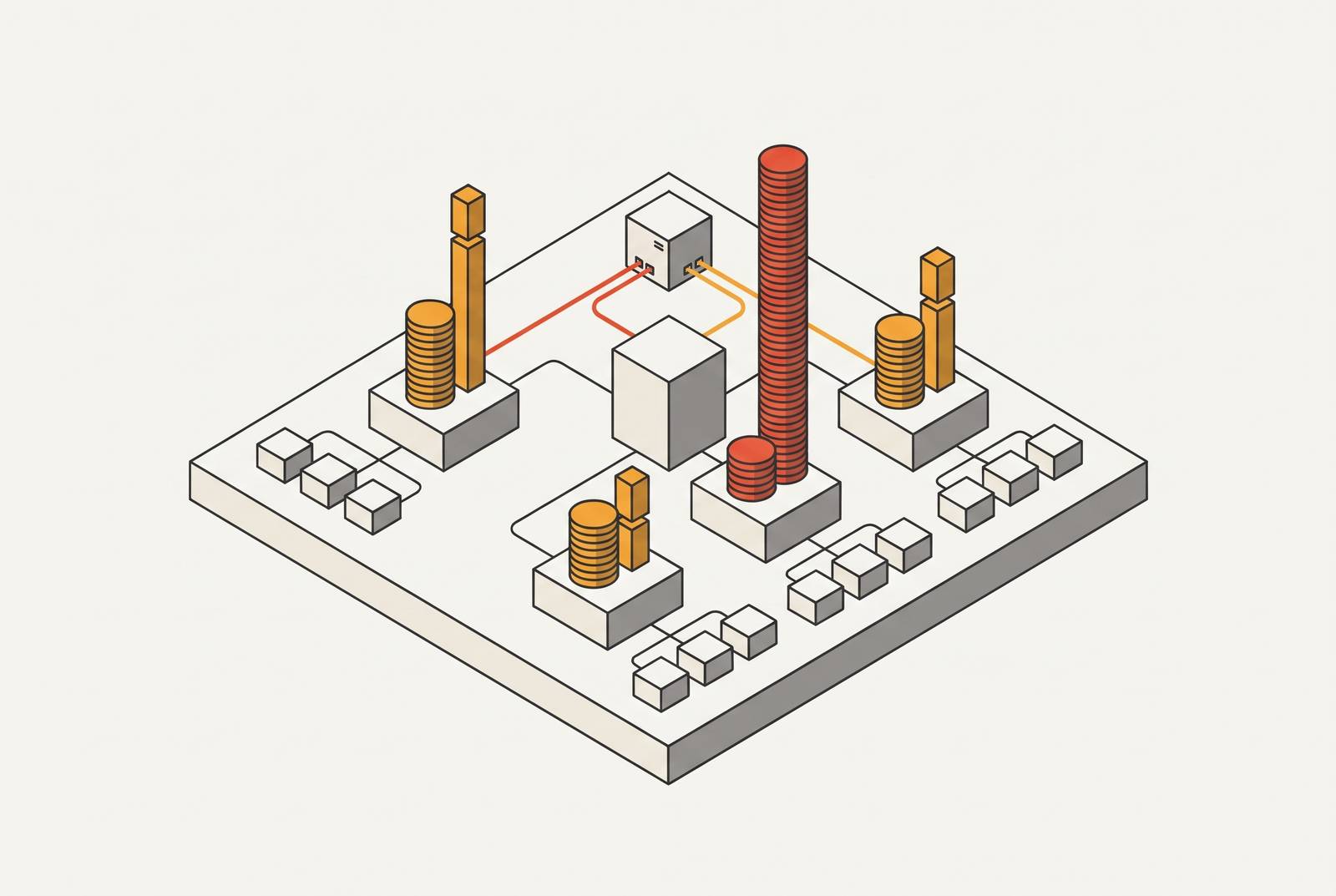
Per-run agent cost attribution for engineering teams belongs in three existing budget lines, which are tooling, infrastructure, and team capacity. Member and workspace controls establish responsibility, team or project allocation assigns consumption costs, and audit logs connect agent activity to output. A VP of Engineering can govern coding-agent spend through these familiar structures rather than inventing a separate accounting system.
Why coding-agent spend feels ungovernable to a VP of Engineering right now
Token-based and compute-based billing meters accumulate charges as agents work, so adoption can change spending before procurement revisits a contract. Uber gave Claude Code to thousands of engineers, reached near-total adoption, and burned through its 2026 AI budget by April, creating a budgeting problem. Successful adoption can expose the absence of consumption controls just as quickly as wasteful use can.
The underlying friction is a mismatch between categories. Agents produce pull requests, which engineering leaders already track, but consume metered services, which finance already knows how to govern. A subscription invoice can conceal both roles behind one vendor name. Separating access, execution, and output gives each component an owner and a basis for review.
The three budget lines a VP already owns that agent spend maps onto
Coding-agent spend fits into tooling and software licenses, cloud infrastructure and compute, and team-level capacity. Tooling pays for access to a harness or service. Infrastructure pays for the resources consumed during execution. Capacity evaluates the engineering output that the combined expenditure buys, using the same comparison a VP makes when considering contractors or augmented headcount.
These buckets answer different questions about the same investment. A license establishes a commitment, while a workspace produces a consumption charge. A merged pull request supplies evidence of delivery. Capacity is therefore an evaluation lens.
Ramp Inspect writes more than half of all merged pull requests at Ramp. Linear internally resolves roughly a third of incoming bug reports with a coding agent, mostly on the first pass. Those contributions are substantial enough to evaluate as capacity. The relevant comparison is the marginal cost of the people whose work agents substitute or augment, rather than an assumed productivity multiplier applied to every developer hour.
How the tooling-and-licenses line works for agent subscriptions
An agent subscription can look like an ordinary SaaS seat while leaving much of the eventual bill unsettled. Access has a fixed cost, while the cost of consumption varies with use. Procurement already manages both forms of contract, but the seat price alone does not reveal which form it is buying. A low access charge may be only the floor.
Claude Code Enterprise costs $20/seat/month, with usage charged on top at API rates. The seat pays for access to the platform, while Claude Code sessions, Claude chat use, and Cowork tasks are billed separately at standard API rates. Claude Code Team Standard costs $25/seat/month, or $20 annually, with Claude Code included. Usage credits change that billing structure. Once enabled, overage bills at API rates, while Team Premium, at $100 annually per seat, provides higher session capacity before that threshold.
Cursor Teams seats cost $100 or $200/user/month through The X Subscription, which has an entry tier below those prices and tiers that were introduced October 12, 2026. Model costs for Claude, GPT, and Gemini bill on top at API rates from Premium upward, an option unavailable on Plus or Free. OpenCode takes a different approach to access. Its core agent is free and available under a permissive open-source license, with customers bringing their own API keys, while Go costs $10/month and Go Plus has a higher monthly rate. There is no seat minimum or usage overage, but model costs pass through to the customer’s provider keys.
For procurement, the governance response is to classify each product as fixed-seat or seat-plus-consumption. A fixed-seat commitment can be approved against a predictable license budget. A metered component needs a spend limit and an alert, just like a cloud service. Procurement must track model usage that is billed separately, even when the charge is on a different provider’s invoice.
How the infrastructure-and-compute line works for agent workspaces
When agents execute in isolated cloud VMs, their workspace costs belong with infrastructure. The closest analogy is a CI runner. Both provide execution resources for a bounded piece of work, and both can be governed through the cloud-cost controls that platform teams already use. Ownership follows the resource.
Ramp’s Inspect architecture makes that cost shape concrete. Modal sandboxes spin up full development environments in seconds and run OpenCode with the tools needed to execute development work. Each sandbox is ephemeral and billed for the task’s duration. Idle time costs nothing in this model. Platforms that charge per workspace minute and bill nothing while workspaces sleep fit into the infrastructure budget.
The appropriate budget owner is the team or project. Individual responsibility can still be relevant to controls, but it does not turn shared execution capacity into a per-seat license. Spend limits, budget alerts, and team-level allocation apply here as they do to other cloud compute. The team that owns the cost also owns security, because running agents under the organization’s control keeps credentials, source, and execution logs within the organization’s infrastructure boundary. For regulated work, keeping execution inside an authorized VPC meets the boundary constraints tied to FedRAMP High and HIPAA, which cover where work runs as well as procurement terms.
How the team-capacity line works when agents ship pull requests
A pull request is a unit of agent output that a team can review. That makes agent spend comparable to a contractor engagement evaluated on deliverables, rather than only to a software subscription evaluated on adoption. Budgeting requires comparing cost per merged pull request with the marginal cost of a contractor or staff engineer producing the same output. A seat count cannot answer that question.
Linear’s workflow illustrates the distinction between execution and acceptance. Its coding-agent approach leans on Claude Code and Codex to review every PR before a human engineer gives final approval. Coinbase built Forge on Linear’s Agent Interaction SDK to work across Slack, GitHub, and Linear using context already in those systems. These agents contribute within existing engineering workflows. Their capacity can therefore be assessed through delivered work rather than through adoption of a replacement process.
Once code generation becomes cheap and parallel, human review, CI capacity, test reliability, and release coordination become the constrained resources. The VP is buying additional review demand as well as code. Capacity planning therefore has to account for those constraints alongside the number of sessions agents can run.
The governance response is a reviewable-PR rate as the success metric for agent capacity. That metric evaluates whether agents supply work the team can act on, while merged PRs support the financial comparison. It keeps what agents run separate from the output the team accepts. It also makes review capacity part of the investment plan.
What the converged internal-agent architecture at Stripe, Ramp, and Coinbase reveals about allocation
Stripe, Ramp, and Coinbase independently converged on four architectural elements, namely isolated cloud sandboxes, curated toolsets, subagent orchestration, and integration with existing developer tools. Sandboxes create compute costs that belong to platform or infrastructure budgets. Access to the harness and model is a tooling cost, while PR throughput measures capacity.
Existing integrations also explain why an agent rollout need not create a new license category for every connection. Ramp’s toolset includes Sentry, Datadog, LaunchDarkly, Braintrust, GitHub, Slack, and Buildkite, all pre-existing line items. Starting work through Slack, Linear, and GitHub makes the integration effort configuration.
Coinbase chose Linear as the place where agents “get their bearings before starting a task”. Linear’s MCP server lets Claude, Codex, Cursor, and other harnesses find, create, and update issues, projects, and comments. The existing license therefore covers that context layer. Its cost does not become a new agent-specific line simply because an agent uses it.
Subagent orchestration introduces a different allocation consequence. One delegated task can spawn multiple child agents, each consuming workspace compute. The shared architecture validates the three buckets while also revealing why infrastructure estimates must account for fan-out rather than assuming every task has the same cost shape.
Where the three-bucket model breaks down and how to handle the gaps
On the same account, Claude chat, Claude Code sessions, and Cowork tasks all draw from Claude Code’s subscription usage. A morning of chat can reduce afternoon coding capacity. The invoice does not distinguish which activity consumed which tokens, so a tooling allocation intended for PR production can fund other work instead.
The governance response is member and workspace spend limits. Team and Enterprise accounts provide these controls, which can be used to separate coding-agent use from general chat use. This uses cloud cost-tagging within the accounting structure already in place. It provides a control layer while leaving exact per-task token consumption unverified. For teams sharing Claude Code or Codex, the distinction is essential because assigning responsibility and measuring a task’s precise cost are not interchangeable.
Several child agents can consume resources for one delegated task, so the infrastructure estimate cannot grow only with the number of tasks. The response is a separate capacity tier for fan-out, with its own spend alert. This keeps orchestration visible in the budget rather than treating it as an ordinary single-agent run.
Zero-data-retention agreements do not prevent source code from transiting a commercial cloud boundary. Standard web proxies and CASBs cannot inspect the payload without TLS decryption. For regulated environments, the response is execution inside organization-controlled infrastructure. Budget ownership and contractual protection cannot substitute for the required technical boundary.
Applying the three buckets to a quarterly agent-spend review a CFO will accept
Tooling shows fixed commitments, infrastructure shows variable consumption, and capacity shows output per dollar. The evidence changes within the existing accounting hierarchy. The VP’s task is to make the relationship between those views explicit enough that a CFO can assess both cost control and delivery.
For the tooling view, the review should identify each harness by seat count, monthly seat cost, and whether usage is included or billed separately. A consumption component that exceeded the seat cost during the quarter warrants a flag. That indicates an infrastructure-led budget treatment for the next quarter. The fixed access commitment can remain visible without obscuring the dominant variable expense.
For infrastructure, the review should total workspace compute by team or project and compare it with CI and ephemeral-environment spending. The target is a cost curve that follows merged PRs. Sleeping workspaces that incur no charges make that relationship easier to defend. Fan-out still needs its separate capacity tier so that additional orchestration does not disappear inside the average.
For capacity, the output-per-dollar measure is the number of merged PRs traced to agent sessions divided by total agent spend. Cost per merged PR supports comparison with equivalent contractor or staff-engineer output. Both depend on attribution. Member and workspace limits establish spending controls, while audit logs showing what agents ran and produced supply the evidence for the review.
Finally, infrastructure that can run any approved harness preserves the comparison across vendors. Claude Code, Codex, Cursor, and OpenCode can then be evaluated on cost per PR without renegotiating the infrastructure contract whenever the harness changes. A model or harness switch becomes configuration. The CFO receives a review of committed cost, consumed resources, and delivered work within financial structures that already have accountable owners.