Agent Compute Costs vs Developer Hourly Rate ROI
Agent ROI depends on loop count and task fit, not just compute versus salary.
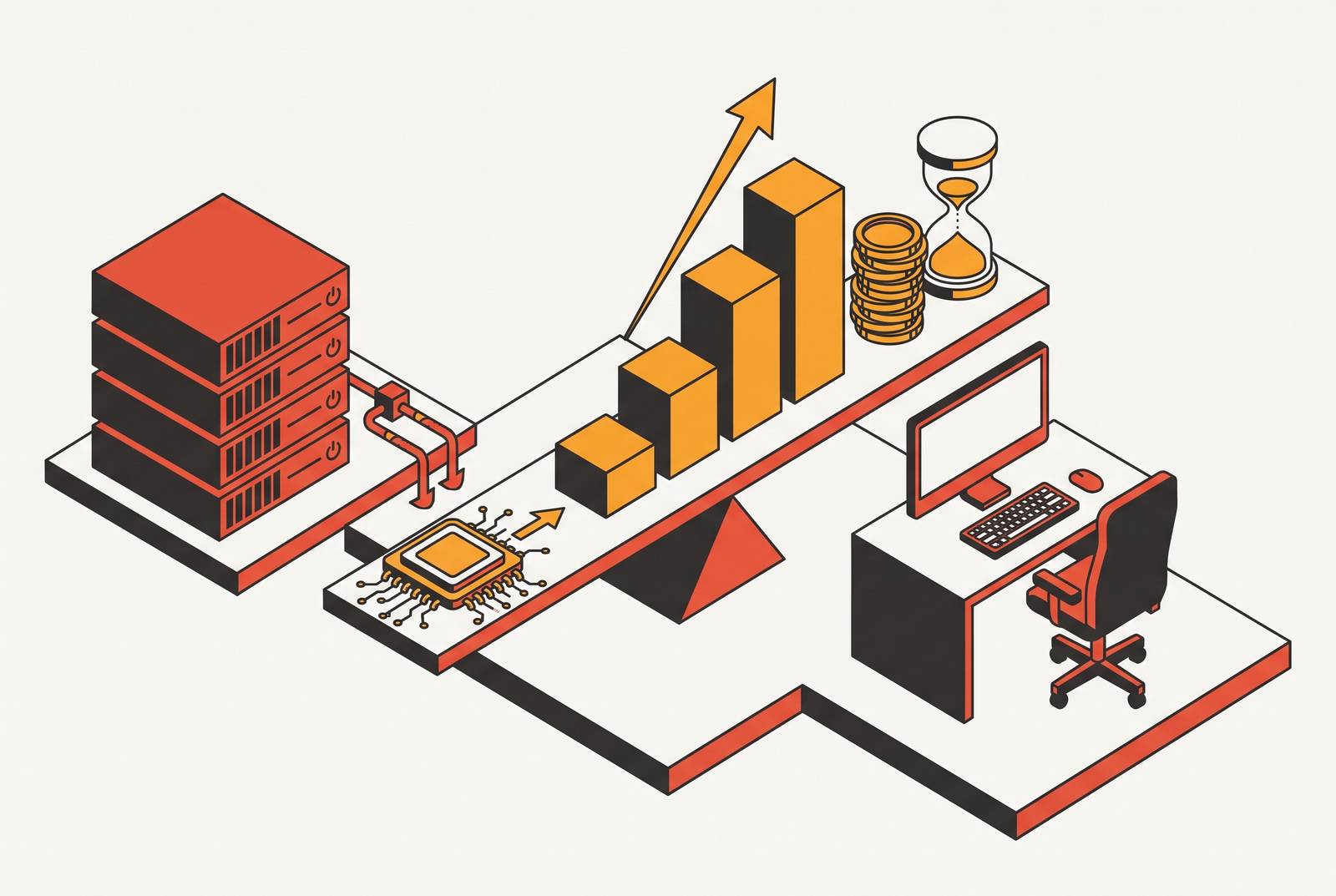
The pitch for coding agents usually comes down to one number: a task that costs a few dollars in compute against a developer whose fully loaded time costs substantially more per hour. That comparison is arithmetically sound but incomplete: the real cost of an agent run depends on how many iterations it takes to finish the work, what kind of task it was given, how much senior engineering time goes into checking the output, and whether anyone can trace the result back to the model and run that produced it. Skipping those four variables means a team will either overpay for tasks agents handle badly or fail to credit the tool for gains it actually delivered. The rest of this piece builds the fuller framework, variable by variable, so the comparison holds up past the first spreadsheet tab.
Why the simple compute-vs-salary comparison breaks down
Most engineering leaders meet this math for the first time in a vendor pitch or a budget conversation anchored on the hourly rate gap. The gap is not invented. DX's pricing guide cites Anthropic's own enterprise deployment data, and it shows average Claude Code spend running well below the cost of even one hour of loaded developer time. On that basis alone, delegating a task to an agent looks like free money.
The trouble starts when you ask what happens after the agent finishes. If a task costs a few dollars in compute but triggers several hours of senior engineer review, it hasn't saved anything. It has shifted the cost to a part of the ledger nobody is watching. Teams that stop at the hourly comparison tend to land in one of two bad places: they hand agents work the agents handle poorly, racking up cost and rework, or they undercount the real throughput gains because nobody tracked which runs actually worked. Both failures come from the same source, a comparison built on one variable when the real one needs four. A complete framework is buildable from the pieces most teams already have on hand, and building it is what the rest of this piece sets out to do.
What agent compute costs, before any variables are applied
Before loop count, task fit, or review overhead enter the picture, it helps to be honest about what "agent compute cost" means in practice, because it is not one number. It depends on the billing architecture, which model tier gets used, and how heavily a team runs agents day to day. Two tools billing for what looks like the same work can land at wildly different price points depending on how the vendor structures the bill.
Subscription-gated pricing buys predictability: a flat fee, no surprise invoice, but also no visibility into what any single task actually cost. Token-metered pricing is the opposite trade. It shows the true cost of every call, but it exposes a team to real budget risk the moment usage climbs. Claude Code's enterprise numbers show average spend well below one hour of loaded developer cost per active day, with monthly costs modest for most users; for heavy users, DX notes the Max plan offers a flat monthly rate that undercuts equivalent API billing by a wide margin. GitHub Copilot tells a different pricing story. It moved to token-based AI Credits billing in June 2026, and the effective Enterprise price now bundles in GitHub Enterprise Cloud. Promotional credits running through August 2026 are currently masking what the baseline cost will look like once those credits expire, DX notes.
That June 2026 shift matters beyond Copilot's own price sheet. GitHub moved away from premium-request quotas, the old model teams had built their budgets around, and the AI Credits system prices things differently enough that a team still budgeting on last year's assumptions is exposed to real per-task cost swings, particularly on code review runs. Compute cost" is a number that shifts and has to be checked continually. A team's compute cost changes under its feet, so any ROI framework has to be built to absorb that instability.
Loop count: the dominant cost driver most teams never measure
The token rate printed on a pricing page is close to useless for predicting what any given task will actually cost. What drives real spend is loop count: how many cycles of planning, editing, and verifying the agent runs before the output passes. That number varies enormously depending on the task, and it is the variable most teams never bother to measure.
The range is wide enough that it can change a team's whole read on affordability. A moderate refactor that takes an agent 10 loops on a high-capability model can cost far more than a quick bug fix that resolves in 2 loops on that same model. Across the full mix of tools and workload types, the spread between the cheapest and most expensive per-task run can be enormous. That spread is the reason teams get ROI math wrong before they even start: they size up a task the way they'd size up a developer's time, as a roughly linear estimate of effort, and budget accordingly. Agents don't work that way. An agent that gets stuck on an ambiguous requirement doesn't slow down proportionally, it loops, and every loop adds tokens.
The fix is to stop treating the published rate as the answer and start measuring actual per-task cost at light, moderate, and heavy loop counts for the specific tasks a team runs regularly, not for a hypothetical single call. Once that data exists, routing decisions can follow the workload instead of the brand name: lighter, well-defined tasks are often cheapest on subscription-gated or low-rate models, while heavier, multi-agent workloads can justify a higher per-token rate if the higher-capability model finishes in meaningfully fewer loops. Platforms that run agents inside isolated, fully-configured sandboxes give teams a way to see that loop count directly, since the agent operates with native access to the codebase and tooling inside its own environment, making it possible to instrument per-task loops against actual token spend instead of inferring the number from a vendor invoice after the fact.
Task fit and whether agent compute is cheap or expensive relative to developer time
Cost is only half the equation. Agents are not uniformly fast or cheap across every category of task, and the teams seeing real returns are the ones that have learned where the line falls. Putting an agent on the right task makes the hourly-rate math hold up. Putting it on the wrong one makes the same math quietly invert.
Agents reliably deliver on work that is well-scoped, bounded by clear context, and judged against criteria that don't require debate: generating tests, refactoring code to a pattern that's already defined, migrating to a documented API, writing boilerplate off a spec. But they add cost without proportionate value when a decision depends on organizational context no prompt fully captures, when a team debugs failures nobody has seen before, or when work has to hold state across a boundary as long as a multi-week sprint, where stale context is a documented failure mode.
Coinbase's experience with its Forge system illustrates how much deliberate iteration task fit can demand. The system cut PR cycle time dramatically, but it didn't get there in one step. It evolved from an early version called Claudebot, through an intermediate stage called Cloudbot, to the system now called Forge, and that evolution added Mux as a layer for coordinating multiple agents at once. Only after that sequence of changes did the system start to produce a meaningful share of merged PRs. Ramp has pursued a similar strategy of routing specific, well-bounded work to its agents, fitting the task to the tool.
Task fit also feeds straight back into loop count. An agent handed a poorly scoped task doesn't just take longer, it runs more loops, burns more tokens, and tends to produce output that needs more review on the back end. Cost, loop count, and review overhead aren't three independent problems. They compound each other, and a mistake in task fit raises the cost in all three at once. Teams that integrate cloud agent platforms into their existing workflows, triggered from Slack, Linear, or GitHub, are better positioned to see this compounding in practice, because they can track which tasks move straight to merge and which ones get stuck in review, and that tracking is what separates a task that's genuinely cheaper from one that has just moved its cost somewhere harder to see.
The review overhead that the compute cost number never includes
The most commonly missed cost in agent ROI math sits outside the invoice. Compute appears as a line item. The senior engineering time spent reviewing, correcting, and retesting what the agent produced does not, and that time is often worth more than the compute it's checking.
Run the numbers on a single scenario: a senior engineer billed at a fully loaded $150 an hour spends several hours reviewing, fixing, and retesting a patch that cost a few dollars in compute to generate. The compute was cheap. The validation was not, and once that engineer's hours are added in, the total cost of that task can run well past what the same engineer would have spent writing the patch directly. A team that only logs the compute line is measuring a fraction of what the task actually cost, and every ROI claim built on that partial number is wrong in the same direction: it looks better than it is.
Review overhead is an argument for measuring it, because overhead that gets tracked can be managed, routed around, and reduced over time, while overhead that goes uncounted just accumulates as a silent tax on every task that looks cheap on paper. Measuring it, though, requires attribution down to the level of the individual task, not a single tool-wide cost figure, which is the problem the next section takes on directly.
Attributing Agent Value to a Task, Model, and Run
None of the previous three variables, loop count, task fit, or review overhead, can be managed without knowing which run produced which outcome. Agent ROI depends on attribution down to the source, the harness, the model, and the credential behind every run, and most teams right now are tracking none of those dimensions. That is the actual gap behind most inflated or deflated ROI claims: not bad math, but missing data.
A workable attribution framework needs three categories of measurement. Utilization covers weekly active users, the rate of AI-assisted PRs, how far adoption extends past basic autocomplete, and session duration, numbers that reveal whether a tool is actually embedded in daily work or sitting unused on the shelf. Impact covers PR throughput, time to first review, the code turnover ratio, and change failure rate. The turnover ratio functions as a kind of early warning: if code written with AI assistance needs materially more fixes after it merges, whatever productivity gain showed up earlier in the pipeline was never real. Cost means the full number, not the invoice line for seats: licensing, token overages, upcharges for premium models, and the infrastructure needed to govern all of it.
Without this attribution, a team averages together its best and worst agent runs and gets a number that looks fine on balance while masking configurations that are actively losing money. Model routing makes the same problem sharper: a team running Claude Code for some tasks and a different model and harness for others cannot draw any honest comparison between them without knowing which run came from which combination, and without that knowledge the comparison is just noise dressed up as data. Analytics platforms built for agent orchestration address this directly by attributing every minute of compute to a source, a person, a harness, a model, and the credential that paid for it, along with the specific skills and tools the agent used along the way. Replicas builds this attribution into its infrastructure by running each agent in its own sandboxed VM, which gives a team native visibility into the full lifecycle of a run rather than a single aggregated bill at the end of the month.
Running agents against a live codebase inside a properly configured cloud environment, instead of guessing at how a task will go, reveals task fit as it actually happens: an agent either moves through a workload cleanly or gets stuck looping, and that outcome can be captured directly and fed back into the cost model instead of estimated from a hypothetical task description. That is the standard a real ROI framework has to meet. The hourly-rate comparison was never wrong. It was just the first line of a calculation that needs four more before anyone can trust the total.