Cloud Coding Agent Pricing for SaaS Engineering Teams
Cost structure choice determines how agent spending scales as your team grows.
Cloud coding agent pricing decides how much agent work a team can run, not just what you see on a monthly invoice. Flat-subscription tools and usage-metered agents respond to growth in opposite directions, which is the structural fact that drives this decision, so the choice a team makes early shapes what happens as usage scales, long after the contract is signed. If one engineer uses a flat-subscription IDE tool like Cursor or GitHub Copilot now and then, or ten engineers run it hard all day, the charge is the same either way. A usage-metered cloud agent, by contrast, such as the Claude Code API, OpenAI Codex on token billing, or Devin on ACU billing, charges in direct proportion to compute consumed, so a team that doubles its agent throughput doubles its bill. A team that underestimates usage on a metered plan ends up with a bill it didn't plan for, and a team that overprovisions on a flat plan either pays for headroom it never touches or hits a hard cap right when it needs more capacity. Picking between these models is a budgeting and capacity-planning exercise, grounded in how a team actually uses agents day to day, well before it becomes a matter of which vendor's logo ends up on the invoice.
What drives costs in cloud agent usage
Cloud agent bills behave differently from flat IDE subscriptions because several mechanics compound in ways a single-session estimate never captures, and skipping any one of them leads to a budget that is wrong from the start. One of the biggest is cache behavior across breaks: when a session pauses and then resumes, the prompt cache may no longer be warm, so the full context has to be re-ingested at full token cost. So stop-and-start usage costs far more than steady usage under per-token billing, and the cost of a break appears on the statement only afterward. Agent fan-out adds another layer: when a single task spawns sub-agents or runs several tool calls in parallel, each branch burns its own token budget, so the final cost multiplies well past what a single straightforward session would suggest. MCP tool definitions passed into context add tokens to every call, and so do higher reasoning-effort settings, so per-task cost rises above what the raw size of the output would suggest. Running several sessions in parallel multiplies all of this at once: the cost of one session, times however many sessions are running side by side. And harness choice changes how these mechanics show up in practice. A terminal agent handling a long-context architectural refactor accumulates cost on a different curve than an IDE agent making bounded inline edits, even when both run the same underlying model.
How major pricing structures behave under real team workloads
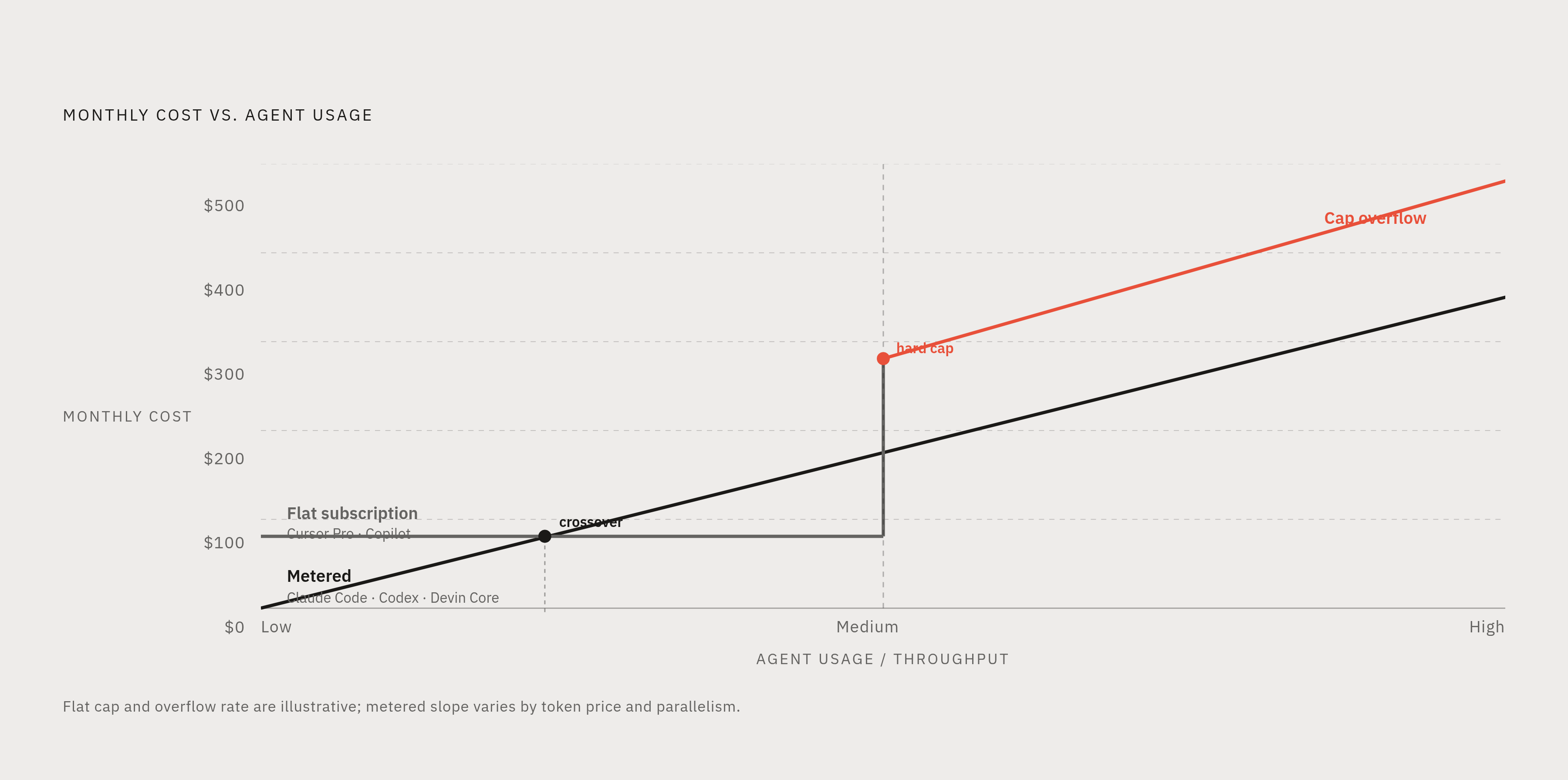
Every pricing structure fits a specific usage pattern well, but it breaks down on a different one, and most teams only find the break-down case after it's already cost them money. Flat-subscription plans, Cursor Pro at $20 a month, or GitHub Copilot's monthly per-user plans at somewhat lower price points, charge a fixed amount regardless of how hard the tool gets used, which suits teams with steady, moderate daily usage spread across many engineers. The trouble starts when a heavy or bursty user runs into session or weekly limits and either stops working or spills over into per-token billing: the "flat" bill stops being flat right at the moment the team needed the most capacity. GitHub Copilot Enterprise adds a cost most teams don't see coming, since it requires GitHub Enterprise Cloud on top of the Copilot seat price, and many teams budget for only one of the two. At the high end of Cursor's and Anthropic's tiers, the highest Max plan reflects a deliberate trade: for a heavy daily user, a fixed ceiling beats open-ended per-token billing, trading away per-token elasticity for a predictable number at the top. Anthropic's own enterprise guidance puts active Claude Code use at roughly $150 to $250 per developer per month on average, with heavy users running well past that, so the top Max tier is the efficient pick for the heaviest users while the entry tier leaves them underprovisioned. Teams also tend to underestimate the real per-seat cost once agents run in team configurations, because each parallel context window burns usage on its own, so you need to count the number of concurrent agent contexts running at once, not just the headcount paying for seats.
Pure pay-as-you-go and ACU billing work on the opposite logic. Devin Core runs $20 a month plus per-ACU charges, and Devin Teams combines a higher monthly team fee with a per-seat charge (the old $500-a-month ACU-bundled Team plan was retired in April 2026). Claude Code's API bills per token, and OpenAI Codex moved to the same token-based model on April 2, 2026. All four scale cost directly with compute consumed, and nowhere in the structure is there a ceiling. So this shape suits you if your workload is spiky or hard to predict, because the bill tracks actual use, not a monthly floor your team might never reach. It breaks down for teams running agents continuously or in parallel, where the lack of a ceiling turns a genuinely productive sprint into a budget overrun. OpenAI's own rate card points to a substantial monthly cost per active developer on Codex, and that number compounds fast once a team multiplies it across its full headcount.
Open-source, bring-your-own-key setups sit at the far end of the spectrum. OpenCode is free under the MIT license, so it charges nothing for the harness itself, and you pay only your model provider's API rate. That makes it the most controllable structure cost-wise, for teams willing to take on the operational work of managing their own tooling and instrumentation. Across nearly all of these options, annual billing cuts cost meaningfully at team scale, but only when the commitment matches usage a team has actually measured, not usage it hopes to have.
How harness choice compounds the pricing decision
Pricing structure and harness choice can't really be separated, because the harness running underneath a model changes both what a task costs and how well the agent performs it. Terminal agents like Claude Code and OpenAI Codex are built for long-context, multi-file, architectural work, the kind of task that naturally accumulates a large context window and runs for an extended session, which happens to be exactly the usage pattern where per-token costs compound fastest. Task type matters here too: performance differs meaningfully across harnesses depending on whether the work is documentation, feature implementation, or bug fixes, and the harness that performs best on one category isn't necessarily the cheapest, and the cheapest isn't necessarily the one that performs best. A common stack of Cursor Pro plus Claude Code Max, for instance, already runs $120 to $220 a month per developer before you add any ACU or overflow billing, so the combination you pick for convenience can carry a real cost before a single task runs long.
Model-agnostic harnesses, OpenCode among them, along with other bring-your-own-key platforms, separate harness cost from model cost. That split lets a team swap the model underneath a given task without touching its harness subscription at all, which is the clearest way to stay flexible as better models ship. Replicas exemplifies this structural separation: it runs coding agents inside isolated cloud VMs and lets teams choose which harness, Claude Code, Codex, Cursor, or Opencode, fits a given task, decoupling the infrastructure cost from any single tool's pricing model so the two dimensions can be optimized on their own terms. That matters because if you lock into one harness just to simplify a bill, you give up the option to route a job to whichever harness performs best on it, and that tradeoff becomes visible only once you already need the flexibility you gave away.
The environment the agent runs in adds costs most pricing guides ignore
A pricing page covers subscription tiers and token rates, but it says nothing about the environment an agent actually runs in, and that layer carries its own cost whether or not a vendor bills for it directly. Agents that install packages, run services, drive a browser, and check their own work need real, isolated compute. A shared environment where one agent's actions bleed into another's state, or expose credentials meant for production, turns a cost problem into a security problem as well. The "propose, dispose in CI" pattern, where the agent's job has only read access and any write happens in a separate job behind required human approval, is the right architecture for that risk, but it adds pipeline complexity and compute cost that never appears on a harness's pricing page.
Cache warming is itself an environment cost. If an agent's VM doesn't come pre-loaded with a team's dependencies and tooling, the agent spends time, and bills for that time, doing setup that a properly configured environment would have already handled. Environment design matters as much as model choice for this reason: cache behavior and context reuse depend on how the agent's VM is set up. Replicas pre-loads each isolated environment with a team's dependencies and tooling, so longer sessions and task switching happen inside a warm, consistent setup, and the agent never has to re-ingest the whole codebase as fresh tokens when a task changes hands. Parallel runs raise the stakes further: running several agents at once requires several isolated environments, because a shared one creates race conditions and state leakage that force re-runs, turning what should have been a parallel efficiency gain into sequential, duplicated cost.
None of this is visible without telemetry that ties a given output back to the run, harness, model, and task that produced it. Without that attribution, a team has no way to tell whether its agent spend is producing proportional output, and every budget decision gets made blind. Teams running several agents in parallel face costs that compound in ways no flat-subscription plan accounts for, and platforms that meter usage-based compute per isolated VM task, Replicas among them, give teams a clear view into what each concurrent run actually consumes, which is what makes predicting and controlling the bill possible as parallelism grows. Replicas is built around this idea directly: every agent run executes in its own VM, pre-loaded with the team's dependencies and tooling, with analytics attributing cost down to the source, the harness, the model, and the credential involved, so the infrastructure layer is part of what a team is paying for, not something it has to build on the side.
Building a budget that reflects actual agent usage
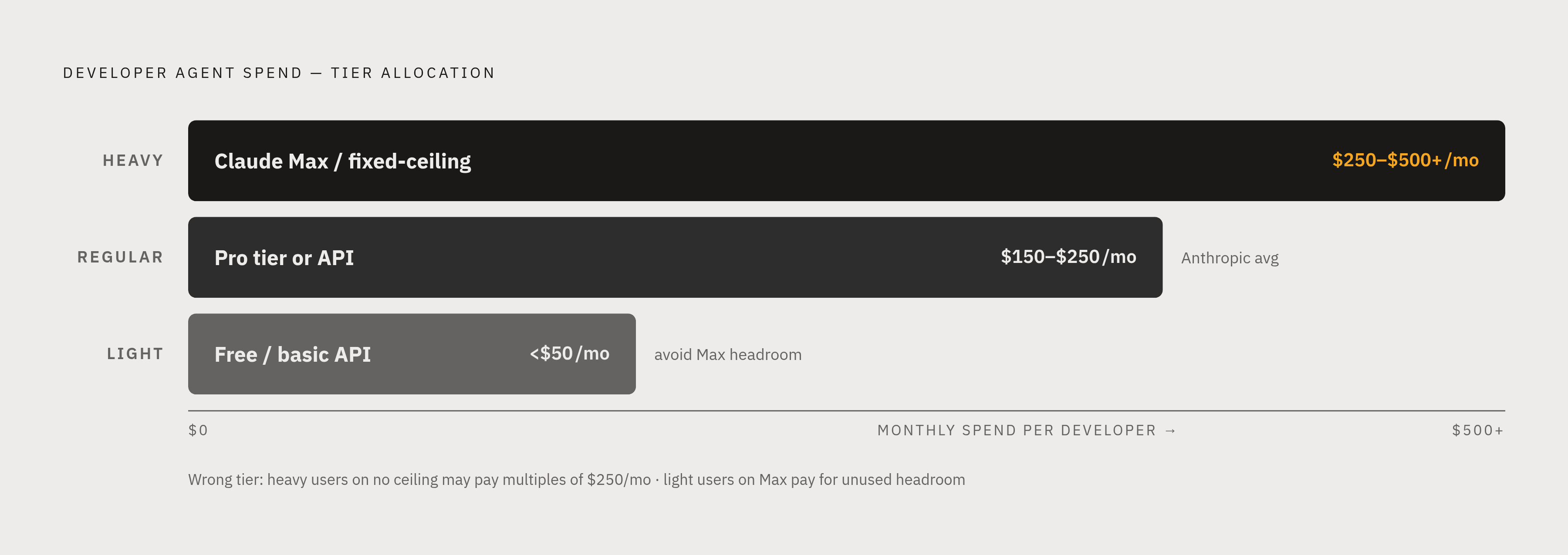
An accurate agent budget starts by splitting a team up by how people actually use the tools, not by applying one per-seat number across the whole org. Daily heavy users, running long sessions, parallel tasks, and frequent context re-reads, look nothing like regular users working a few bounded tasks a few days a week, and light or occasional users look like neither. Anthropic's enterprise figure of $150 to $250 a month per developer on per-token billing is a reasonable baseline for the average case, but heavy daily users can run multiples of that, and for them a fixed ceiling, like the top Claude Code Max tier, is the more cost-efficient choice. Light users placed on that same high tier end up paying for headroom they'll never touch, and Pro or straight API billing serves them better.
From there, the estimate needs to account for the parallel-session multiplier. Engineers who regularly delegate more than one task at a time are running more than one concurrent agent context, and the per-developer number has to reflect that count, not just the number of humans holding a seat. Spend caps and anomaly alerts belong in place before rollout, not after, because the patterns that cause bill spikes, long sessions, cache misses after a break, agent fan-out, MCP tool definitions piling tokens onto every call, are predictable and can be instrumented in advance. Teams that only discover them on the invoice have already paid for the lesson in full.
Cost alone isn't the whole measure. Track code turnover ratio alongside spend, because it tells you whether the code an agent produced is surviving contact with production or getting rewritten shortly after merge; if the turnover ratio is high, you're paying for work that gets thrown away, a negative return no matter how reasonable the token bill looks on its own. And the pricing structure that made sense last quarter may not hold up this quarter, because models keep shipping and harnesses keep changing how they bill, the way Codex did on April 2, 2026 when it moved to token-based pricing. If you lock into an annual commitment before you have a real usage baseline, you trade away flexibility for savings that may never materialize. The teams that get this right are the ones that can see, directly and continuously, what they're spending and what that spending actually produced, against what arrives on the invoice at the end of the month.