Cost Scaling Patterns as Agent Parallelism Increases
Adding parallel agents multiplies token costs without multiplying useful output.
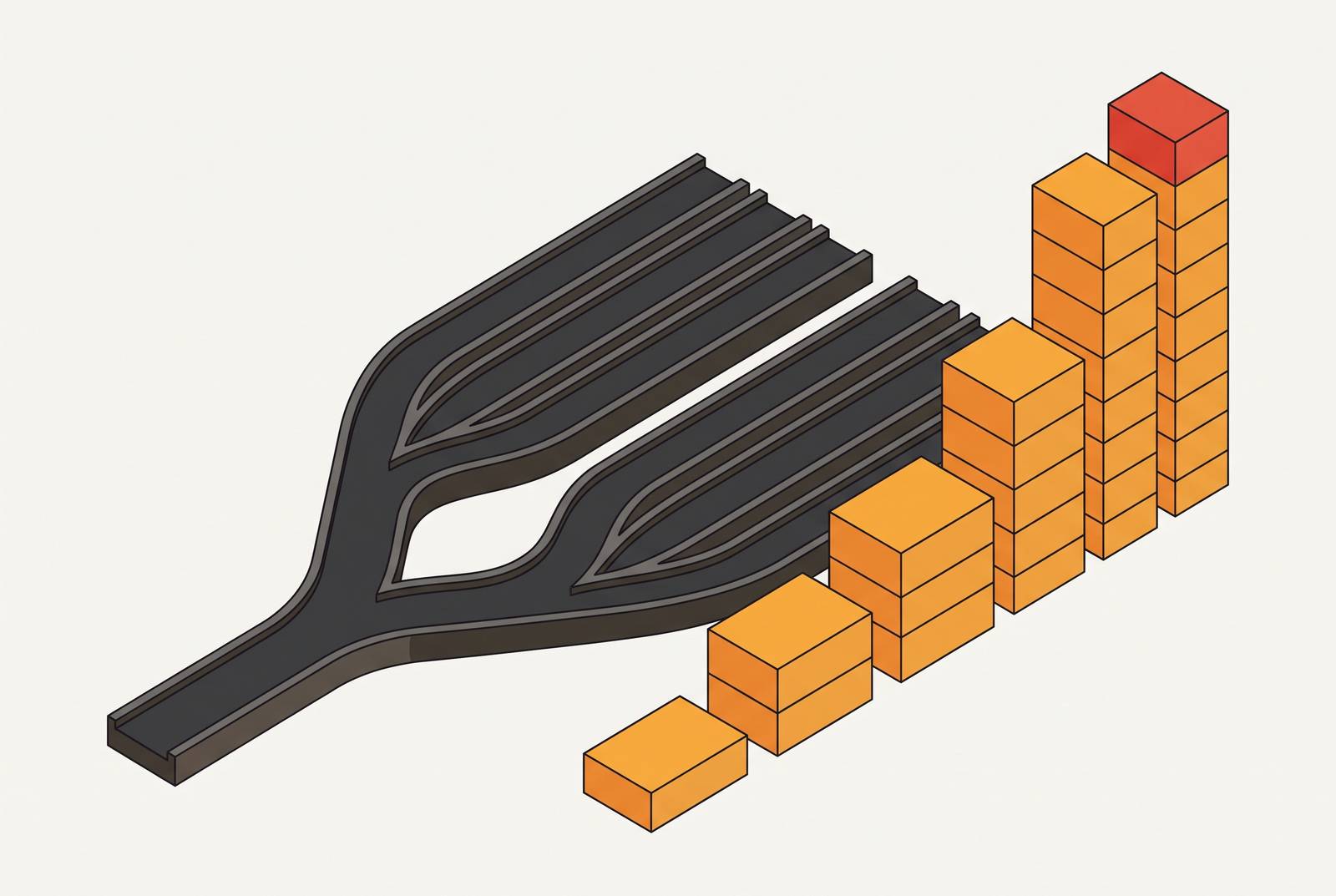
A bring-your-own API key cloud coding agent runner separates the cloud execution environment from the model usage paid through the team’s API balance. Session costs grow linearly, but cost per accepted task depends on model selection, context growth, coordination, and review capacity (not agent count alone).
Why token costs scale linearly but value does not
Claude Code’s official agent-view documentation states that background sessions consume subscription usage in the same way as interactive sessions. Ten parallel agents therefore use quota roughly ten times as fast as one. The agent-teams documentation explains the underlying mechanism. Each teammate has its own context window and consumes tokens independently. Under this billing model, parallel agents have no separate pricing, discount, or volume tier.
That multiplication makes the starting budget predictable. It does not make useful output equally predictable, because agents spend tokens on more than the changes ultimately accepted. Context window growth, planning, inter-agent communication, and merge conflict resolution add work beyond the original task. Linear cost growth is therefore not itself the problem. The problem arises when teams assume that multiplying sessions also multiplies accepted output, without accounting for the work those sessions create for one another.
What the baseline cost curve looks like across fleet sizes
The baseline moves from a single session’s consumption to the combined consumption of every active session. A five-to-ten-agent fleet is already a four-figure monthly line item under the usage assumptions described here, beyond what a single Max plan completely covers. That is a planning reference. Task length and intensity determine where an actual fleet lands, while concurrent sessions determine how quickly it consumes the available balance.
Lighter tasks will produce a lower bill. The useful comparison is therefore between fleets doing comparable work, rather than between agent counts detached from their workloads. At that baseline, each added session uses its own tokens, with no fleet discount assumed. This establishes the reference curve against which overruns can be understood. Once an added agent also expands context or creates reconciliation work, the budget becomes a FinOps problem rather than simply a purchasing decision about another session.
The three places where costs compound beyond the base multiplication
Model token weight changes how much the same work costs. Heavier planners can read more files before they edit, and different tokenizers produce different token counts for the same text. The official Terminal-Bench 4.0 leaderboard includes GPT-6 Astra (Codex) and Claude Fable 5.1, with scores that vary by snapshot and harness. The cited benchmark runs list roughly double the cost for Claude, though the scores are much alike and do not always match. The comparison illustrates why fleet estimates need task-level costs.
A long-running agent retains user messages, tool calls, raw outputs, plans, validation steps, retries, and orchestration metadata. Stack traces and file diffs can remain in the input for subsequent calls, so the next step includes both new work and accumulated history. Claude Code’s documentation puts agent-team usage at approximately 7× the tokens of a standard session when teammates run in plan mode. Each teammate has its own context as a separate Claude instance, so costs multiply with both task length and session count.
Coordination costs more even when it adds no functionality that gets accepted. Upstash’s ten-parallel-agent test found that seven of nine approved pull requests hit merge conflicts. An extra resolution stage added more to the token bill than the original four-stage pipeline combined. Inter-agent messages also require model round trips, so communication consumes tokens even before reconciliation begins. The cost implication is distinct from choosing an expensive model or retaining too much context, because independently efficient agents can still produce expensive work when their changes collide.
Where infrastructure cost fits — and why it is almost never the main variable
Upstash’s sandbox cost roughly one cent for the whole day of testing, including multiple pipeline runs, while the agents’ token bill came to several dollars. The reason lies in what the agents were doing. Most runtime involved waiting for LLM API responses, and the sandbox charged only for active compute. This billing distinction explains the gap in that test, rather than establishing a universal price for cloud infrastructure.
Pausing a sandbox during human review stops billing while preserving disk state. Snapshotting a configured base environment also turns repeated setup into a one-time operation. Both are useful, particularly for execution speed and long-running tasks, but they address a smaller budget component than tokens. For teams choosing a hosted runner, the lesson is to distinguish compute charges from model charges and their respective limits. Upstash includes model usage up to a monthly cap, with the option to supply an API key or raise that cap.
Fleet composition as the primary cost lever
The first control is to assign model weight to task weight. Expensive models do the planning and orchestration, while cheaper models take on the execution work they can handle. This preserves the fleet’s access to stronger reasoning without paying for it in every slot. The unit of assignment is the task. A bounded execution step and a planning step do not justify identical model spending merely because both run as agents.
The Artificial Analysis Coding Agent Index reports Cursor’s Composer 2.5 at roughly 10–60× lower cost than the two agents ahead of it on that index. That makes it a candidate for high-volume, lower-complexity execution in a mixed fleet. Rates change, and any particular pricing advantage can change with them. The durable principle is tiering by the work required. Benchmark position and benchmark cost together provide evidence for that decision, but neither establishes the cost of every task a team will assign.
A model with a higher token price may complete suitable work with fewer tokens and fewer retries than a cheaper alternative. Subscription price alone cannot settle that comparison. The practical measure is cost per merged PR, which connects model selection to an accepted result. A tiered fleet succeeds when its assignments reduce that measure without transferring the savings into downstream rework.
Task decomposition as the second cost lever — and the harder one
Poor task decomposition turns parallel execution into paid reconciliation. Agents starting from the same base can produce overlapping edits, merge conflicts, and rework, all of which consume additional tokens. In the Upstash test, the shared collision point was a test file to which multiple agents added tests. Tasks that seem separate can also overlap in shared configuration files and data models. Independence must therefore be assessed at the level of the files and structures being changed.
Each agent starts with a clean context, works within a bounded scope, and returns a pull request that can merge without conflict. Interdependent tasks require a different allocation of effort before execution begins. A planning agent or orchestrator can assess task independence, estimate context weight, and route work to the appropriate model tier before spawning agents. That planning has a token cost, but it can prevent the larger expense of a 20-agent conflict cascade.
This makes decomposition harder than changing a model setting. The engineering team has to decide where work can separate cleanly and where it remains coupled. Heavy orchestration is justified when it resolves that question before fan-out, rather than merely adding a planning stage to every job. The cost comparison is between planning now and reconciliation later. Treating all planning overhead as waste overlooks the coordination expense it can displace.
The review bottleneck that parallelism creates and how to account for it
Parallel generation can outgrow the capacity to review its output. At that point, token spending remains visible while the costs of rework, incidents, and technical debt sit outside the model bill. METR’s randomized controlled trial found that experienced developers using AI tools took longer on real tasks while believing they had been faster. That finding shows why a sense of working faster is a poor reason to expand parallelism beyond what a team has shown it can review.
The Cortex Engineering Benchmark 2026 found that PR volume rose as incidents per PR also went up. A merged PR is not necessarily the end of the expense. Incident response and rework belong in the assessment of what it cost to produce that change.
A team in that position should account for downstream incident and rework rates when evaluating cost per merged PR. Otherwise, cheap generation can look like a saving even when it leaves more work to do after acceptance. Review capacity becomes part of the fleet’s operating constraint. This also changes the meaning of productive concurrency. The useful level is the amount of output the team can absorb reliably.
The metrics that let teams know if the cost-to-output ratio is drifting
Cost per accepted task shows how much was spent on work that can be used. Cost per seat and cost per agent-hour do not show whether an agent’s work passes review or needs major changes. Cost per merged PR provides a similar anchor for coding work, with downstream outcomes included in its interpretation. A fleet whose low token bill accompanies frequent rework has a less favorable economic result than that bill alone suggests.
Run-level attribution explains where the spending originates. The relevant record identifies the agent, model, harness, credential, and token consumption for each run. Those dimensions let teams distinguish a costly model assignment from a costly workflow or an unproductive tier. Without attribution, a fleet total conceals the decision that caused it. This is especially important in mixed fleets, where a low average can obscure expensive work concentrated in particular task types.
Tracking outcomes for thirty days shows what happens after the work is accepted. Stable cost per merged PR paired with a rising incident rate after a parallelism increase indicates that the apparent stability excludes part of the expense. Budget gates and model-routing rules then turn those observations into controls. A cap on subagent fan-out bounds expansion, while routing assigns model weight to task weight. Without those mechanisms, the measurement system describes drift but does not prevent the same spending pattern from recurring.
How the cost curve changes as agent count moves from single digits to fleet scale
At one to three agents, model selection dominates the cost comparison. An all-heavy-model fleet already costs significantly more than a tiered fleet, while task overlap is rare enough that decomposition is not yet the main discipline governing spend. At five to ten agents, the balance changes. Context accumulation and merge conflicts become structurally likely, so decomposition and snapshot-based environment management gain importance. Cost per merged PR also begins to diverge from what the token bill alone predicts.
At ten-plus agents across a team, the mechanisms interact. Model weight, context growth, and coordination can all add expense at once, while review capacity becomes the binding constraint. Controlling only one leaves the others free to erode the return on spending. To keep the fleet running, teams therefore need routing rules, run-level attribution, and review capacity that grows with PR volume. Agent count is an incomplete planning measure at this stage.
Isolated, fully configured cloud environments provide a reliable execution foundation. Each agent has its own VM, pre-loaded dependencies, and an environment as capable as a local developer machine. That consistency supports task decomposition and parallel execution without turning environment setup into another source of brittleness. It does not remove shared-file conflicts or expand human review capacity.